Design Strategy: What Is It, Really?
For a long time, I thought I understood design strategy.
In college, whenever a lecturer asked for a strategic direction, I knew exactly what to do: establish the 5W+1H formula (the why, what, who, where, when, and how), curate a mood board, pick a colour palette, and write a clever rationale about emotion, lifestyle, and the aspirational user. Present it with confidence. It looked like strategy. It felt like strategy. Everyone nodded along.
It wasn't strategy.
It wasn’t until I moved across the world that I truly understood the difference.
What I Thought Design Strategy Was
When I was a design student and in my early career working as a designer in Indonesia, my hometown, design strategy was mostly just a fancier way of thinking about aesthetics. It was the why behind the what, but that "why" was still based on visual taste, cultural mood, and personal beliefs.
To be fair, that wasn’t completely wrong. Skill and visual sense are really important in design. But what I was doing was more about visual positioning and styling directions than true strategy. I decided how something should look and feel, then created a story around it. The direction could change depending on a new image, a trend report, or honestly, what the most senior person in the room wanted that day.
A big part of it was educated guessing wrapped up in confident words.
The Shift: From Taste to Translation
When I moved to Europe to work in Scandinavia, first Sweden, then Denmark, I encountered a different design approach. It’s not about being better in every way, but fundamentally different in how design was expected to operate within a business.
Design decisions were expected to connect to business goals, yes. But I want to be careful here because that phrase can be misunderstood.
In many companies, people assume designers are hired just to make products look good while using the cheapest materials and methods to maximize profit. Business leaders often have a narrow view of design, seeing it only as aesthetics and cost control. If design strategy was only about that, it wouldn’t be worth discussing.
What I experienced in Scandinavia was different. Design strategy meant considering many stakeholders at once, not just following the loudest business voice.
Yes, business goals matter. Ignoring commercial reality is not a strategy, it’s a fantasy. But business goals are just one part. Real design strategy also thinks about the end user—their needs, wants, safety, and comfort. It considers the people making the product and their working conditions. It looks at the environmental impact of every material and process, from raw materials to disposal. And it protects the brand’s long-term value, which can be quietly damaged by years of choices that focus only on short-term profits.
That’s why I call design strategy a translation layer, but one that works both ways. It’s not just about turning business goals into design choices. It’s about blending user needs, manufacturing constraints, sustainability requirements, and business goals into a direction no single group could create on its own.
That’s when I realized design strategy isn’t just a mood board. It’s a translation layer.
A designer’s job is to honestly manage that complexity, speak up for views that might be overlooked in a room focused on quarterly targets, and show with evidence why the right design choice is also the right business choice. Sometimes that means pushing back. Sometimes it means helping the business see what it really needs. That’s not being difficult. That’s the job.
What This Looks Like in Practice: CMF as Strategy
I specialise in CMF, Colour, Material, and Finish, which might seem like the most aesthetic part of industrial design. But in reality, it carries a lot of strategic weight.
Let me share a clear example of what I mean and how my thinking has changed.
Early in my career, working in a fast-paced product environment in Asia, CMF choices mostly gravitate to one question: does it look good? The deadlines were tight, the pressure was constant, and there wasn’t much time to think beyond the surface. If a colour was trending, you used it. If a plastic surface needed to feel premium, you painted it. No one stopped to ask what premium really meant or what it might cost later, financially or environmentally.
When budgets got tight and painting was cut? The default solution was simple: keep it black and make it glossy. High gloss black plastic became the universal sign of premium. It looked expensive without anyone needing to explain why.
Here’s what I know now that I didn’t back then: black plastic in consumer electronics is one of the hardest materials to recycle. The carbon black pigment that gives it that deep, rich look is almost invisible to the infrared sensors used in sorting facilities. That means it gets filtered out of the recycling stream and ends up in landfill instead of getting recycled. And the high gloss finish? It requires the entire surface covered in protective film during manufacturing and assembly to stop scratches, creating a lot of plastic waste before the product even reaches customers.
We were focusing on making things look premium while quietly creating real costs elsewhere—in waste, recyclability, and long-term brand trust. That’s not a strategy. It’s a decoration with a deadline.
Real CMF strategy, and design strategy in general, means balancing all these factors at once: how a product family looks across a portfolio, how material choices position a product in its price range, how surface treatments hold up over time, and how the product behaves at the end of its life. Sometimes this means suggesting a higher upfront cost, a better material or process that costs more per unit but reduces manufacturing waste, extends the product’s perceived life, or avoids sustainability issues that would be much more costly to fix later.
Making that case, turning a design choice into a business argument, is what strategy is all about.
The Part Nobody Talks About: Alignment Doesn't Mean Surrender
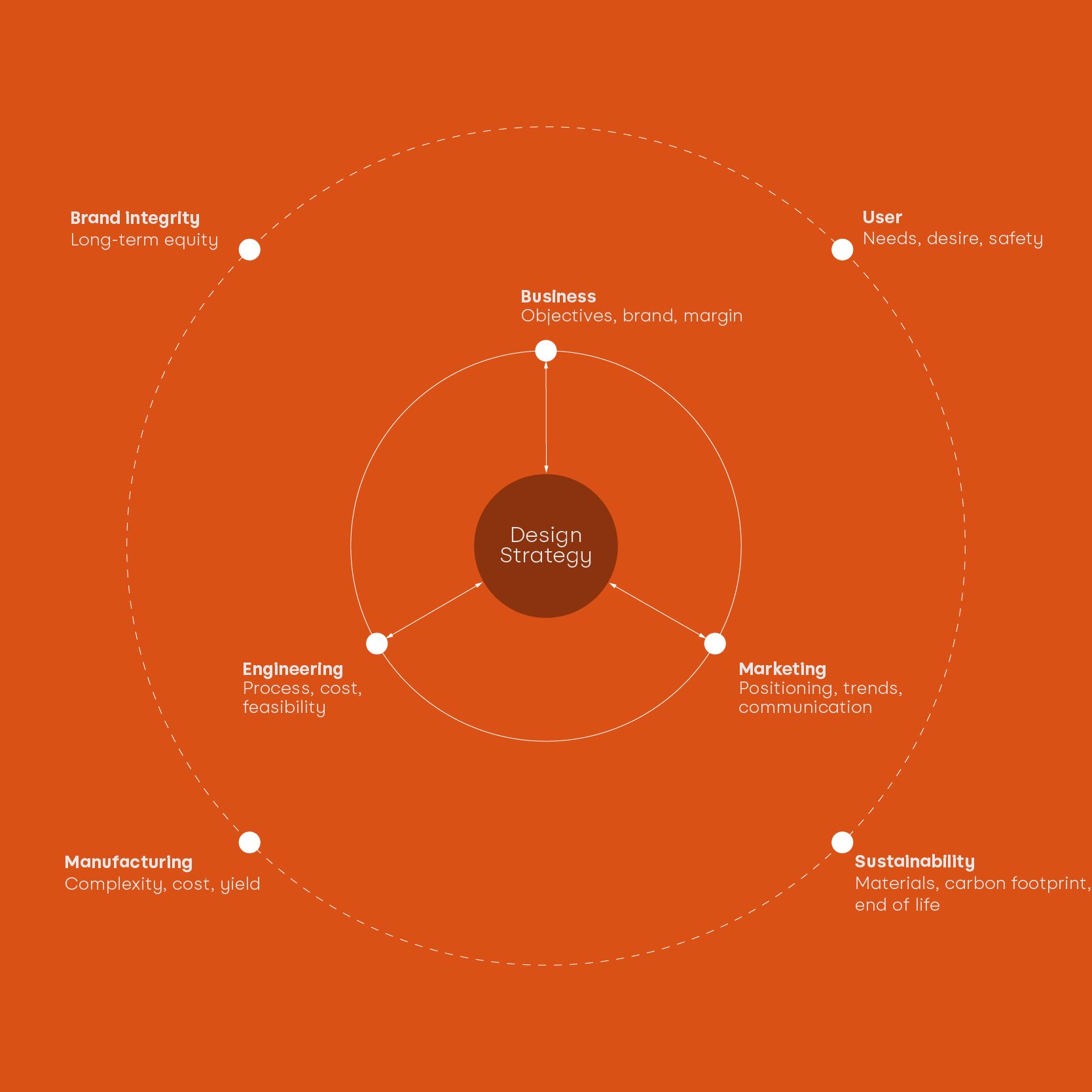
This is a simplified design strategy diagram. There may be more stakeholders and factors to consider in reality.
Design school doesn’t prepare you for this: the strategy document itself isn’t the real goal. The real goal is alignment.
You might create the most elegant, detailed design strategy out there. But if engineering doesn’t buy into it, marketing wasn’t involved in shaping it, or the product manager sees it as a limitation instead of a help, it will just sit forgotten in a shared folder.
I want to be clear about what alignment really means. It’s easy to think it means designers should just make everyone happy or follow the loudest voice. That’s not alignment. That’s giving up.
In the organisations I've worked in at their best, every discipline owns its domain. Engineering has its agenda. Marketing has its agenda. Finance has its agenda. And design has its agenda. We are the experts in design, just like marketers are experts in marketing. That expertise means we have both authority and responsibility to stand up for design choices, defend them when questioned, and push back when another discipline's priorities would genuinely compromise the integrity of the product.
This means adopting what I’d call a legal mindset, being a lawyer for design. You build your case, gather your evidence, anticipate counterarguments, and present your position with both confidence and tact. You won’t always win, but you always come prepared to defend what you believe is right, and you speak in a way others can understand.
The goal isn’t to dominate the conversation. It’s to make sure design has a real seat at the table, not just a courtesy spot or decoration, but an equal voice in decisions that shape the product. Good alignment means every team has been heard, understands each other’s limits, and agrees on a direction together. Design doesn’t fade away in this process. It shows up fully.
What I'd Tell My Younger Self
If I could talk to my college self, carefully arranging mood board images, here’s what I’d say:
Aesthetics aren’t the strategy. They’re the result of it.
Before deciding how something should look, you have to know why it exists, who it’s for, what the business wants to achieve, and which limits like cost, sustainability, time, or technology can’t be changed. Design strategy comes before you even open a design tool.
It also has to be honest. Not every choice comes from pure design vision. Sometimes the smartest design decision is the one that makes the product easier to manufacture at scale, cuts down material complexity in the supply chain, or helps the company reach a price that opens a new market. That’s not a compromise. That’s design doing its job.
Why This Matters for the Industry
I spent the majority of my career in the consumer electronics industry, and it is a tough field for this kind of thinking. Products sit on shelves right next to competitors. Margins are tight, product cycles move fast, sustainability is under more scrutiny, and expectations for quality have never been higher.
In this setting, designers who create beautiful work and link that beauty to business results, can confidently talk with engineers, marketers, and the leadership teams, are the ones who really influence what gets made.
Design strategy is what earns you that seat at the table.
It’s not about a mood board. It’s about having a clear rationale that stands up when tough questions come up.
A Note for Design Students
If you're still in school and reading this, I want to leave you with something direct.
You don’t have to wait until you work at a big company to start thinking strategically. You don’t need a senior title, a spot in a business review, or approval from a lecturer/professor. You can begin right now, with your next project or critique.
Here’s a simple habit to develop: before you open a design tool, grab a reference image, or create a slide, ask yourself why. Why does this product need to exist? Who is it really for, and what do they need it to do? What would success look like for the business, and how does your design help achieve that? What are the real limits—cost, materials, manufacturing, time, sustainability—and how do they affect what’s possible?
Only after you've worked through those questions should you start thinking about how it looks.
Here’s something no one in school will say clearly enough: your mood board isn’t your strategy. It’s the result of one.The images you pick, the colors you like, the textures that feel right—all of that should come from strategic thinking, not replace it. When you show a mood board to a hiring manager or design director, they’re not just judging your taste. They want to see that you understand why those choices fit this specific problem.
That’s the paradigm shift to make: from just a visual curator to a strategic thinker with strong visual skills.
You can do both. Don’t wait for the industry to teach you strategic thinking. Start practicing it today.